Tuesday, August 2, 2011

LETTER: Thank you ‘Creek Keeper'

LETTER: Thank you ‘Creek Keeper'

Published: Thursday, June 23, 2011 at 3:30 a.m.
Last Modified: Wednesday, June 22, 2011 at 7:08 p.m.
Dear Editor: I'd like to express my thanks and best wishes, albeit from afar, to John Watham and the "Friends of Hurricane Creek." Thank goodness for the leadership that John Watham has provided in the past, and is providing now with his thoughtful and caring plan to clean up Hurricane Creek in the aftermath of the April 27 disaster in Tuscaloosa.
His "old school," natural methods clean-up plan is the right thing to do. And it's not surprising he'd organize a plan like that in view of the history of Mr. Watham's "Creek Keeper" efforts and the overall efforts of the "Friends of Hurricane Creek", with their annual creek clean-up weekends.
I'm sending a little extra "Friends" membership donation this time that I know will be put to good use on old Hurricane Creek, the creek I grew up swimming and fishing in during my childhood and teenage days. Just wish I was closer so I could be there with my hip boots and gloves to give a hand.
John L. Wiley, Tuscaloosa native
Newport News, Va.

Thursday, July 7, 2011

$650K targeted for creek cleanup

$650K targeted for creek cleanup

Published: Thursday, July 7, 2011 at 3:30 a.m.
Last Modified: Wednesday, July 6, 2011 at 11:50 p.m.
TUSCALOOSA | Tuscaloosa County will receive nearly $600,000 from the National Resources Conservation Service to clean up creeks clogged by downed trees and other debris from the April 27 tornadoes.
The grant will pay for cleanup in parts of eight creeks at an estimated cost of $648,515. The county will contribute 10 percent, which comes to $64,852, as required by the federal grant.
“This is money that we applied for from the NRCS’s Emergency Watershed Protection program and is specifically aimed at creeks and streams that have been impacted,” County Engineer Bobby Hagler told the Tuscaloosa County Commission, which formally accepted the money at its meeting Wednesday.
Photo copyright by JLW
Hurricane Creekkeeper John Wathen said he was pleased that the county obtained the grant.
“This sounds like real good news, and it looks to me like this is a chance for organizations like ours, which are already working to clean our watershed as much as we can, to partner with the county,” Wathen said.
“I don’t know the details of the grant yet, but it sounds like a good start, especially for some of these creeks that do not have watchdog groups like ours.”
The targeted areas and the estimated costs are:
-- Hurricane Creek at Holt Peterson Road, $188,280;
-- Hanna Mill Creek at Hannah Creek Road, $39,429;
-- Duck Creek at Teal Circle, $48,050;
-- Boone Creek at Bill Lunceford Road, $28,122;
-- Cypress Creek at Martin Luther King Jr. Boulevard, $102,998;
-- Davis Creek at Hannah Creek Road, $128,327;
-- Hogstick Creek at Hannah Creek Road, $75,831.
County Commission Chairman Hardy McCollum said the county’s share of the cost will come out of its emergency fund and speculated that some of it could be deferred until the next fiscal year, which begins Oct 1.
“Like a lot of the damage to our city and county, this is a long-range project and can’t be accomplished overnight,” he said.
Reach Tommy Stevenson at tommy.stevenson@tuscaloosanews.com ore 205-722-0194.


Tuesday, June 14, 2011

Group wants to be careful clearing Hurricane Creek


Creekkeeper John Wathen, of the environmental organization Friends of Hurricane Creek, says he wants to clean up Hurricane Creek using “old school” techniques. The cleanup process using a natural method began Saturday and is expected to take at least a year.
Photo John L. Wathen
Published: Tuesday, June 14, 2011 at 3:30 a.m.
Last Modified: Monday, June 13, 2011 at 11:25 p.m.
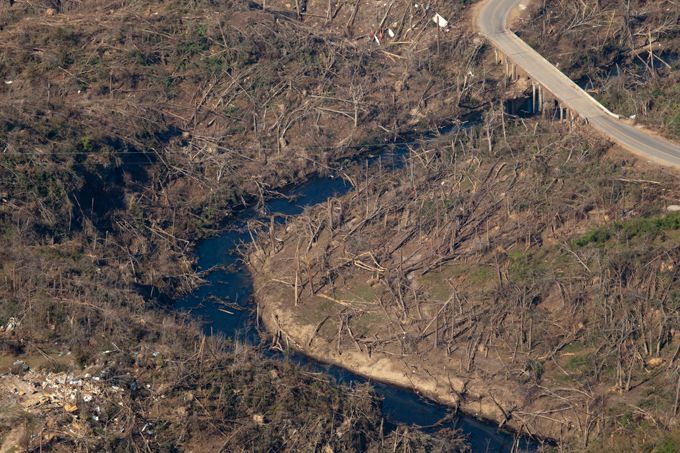
Hurricane Creek was a popular recreational area before the tornado. On April 27, it was the final resting place for three of the storm’s victims. Now it’s cluttered with a mangled mobile home, dead trees and piles of debris.
Although the storm swept over Hurricane Creek and stripped its ridges of anything green, new vegetation is growing.
“It’s bent but it’s not broken,” said Creekkeeper John Wathen, of the environmental organization Friends of Hurricane Creek.
He wants to assist the natural process of restoration, not replace it.
“We don’t want to clean it up fast,” Wathen said. “We don’t want the government and FEMA to get involved because if they do, they will bring in machines and destroy everything.”
Wathen plans to use what he calls “old school” techniques, which is why he brought in Russell Freeman, an arborist from Humboldt County, Calif.
Wathen and Freeman worked together on the cleanup of the Gulf Coast after Hurricane Katrina in 2005. Wathen said he knew Freeman was the man for the job because of his expertise in ropes and pulley systems.
“This whole area will look like a spider web,” Wathen said. “We plan to rig ropes in ways to lift the debris out and this way we do not have to use machines. It will be all natural.”
Wathen and Freeman agreed that the trees torn by 100 mph winds can be converted to mulch and lumber.
“Initially people just want to get the debris out, but if you take a step back and look, the trees can be used to restore the community,” Wathen said.
Wathen said 100 cubic yards of mulch purchased commercially typically runs about $1,800, so this process could save taxpayers a lot of money.
The process to clean up Hurricane Creek using a natural method is expected to take at least a year. The process began Saturday at 8 a.m. and will continue each weekend at the creek on Holt Peterson Road, Wathen said.
Volunteers are invited to participate in the clean-up effort. Those wanting to join in should wear closed-toed shoes that can get wet and bring long pants and long-sleeved shirts. Water and snacks will be provided.


You might like:

Monday, June 13, 2011

No rules cover dealing with asbestos in damaged homes

Tuscaloosa News

No rules cover dealing with asbestos in damaged homes

State, EPA say that safety rules aren’t necessary

T.R. Pate, a contractor for Tree Farm in Fosters, sprays water on a house on 15th Street to keep asbestos down during demolition on Wednesday. Pate said it makes the process safer for workers and the environment.
Buy Photo Michelle Lepianka Carter | The Tuscaloosa News
Published: Monday, June 13, 2011 at 3:30 a.m.
TUSCALOOSA | The 20 or so damaged homes that Tree Farm contractors have already demolished were given a heavy dousing of water before, during and after demolition.

Facts

About asbestos:

Neither the U.S. Environmental Protection Agency nor the Alabama Department of Environmental Management requires contractors to ensure the safe and proper handling and disposal of asbestos from single-family homes.
The EPA does offer some tips on how to reduce exposure to the known cancer-causing agent. Below is a few of the EPA’s suggestions. The full list can be found here: asbestos/pubs/ashome.html.
- Keep activities to a minimum in any areas with damaged material that may contain asbestos.
- Take precautions to avoid damaging asbestos material.
- Have removal and major repair done by people trained and qualified in handling asbestos. It is highly recommended sampling and minor repair also be done by professionals.
- Don’t dust, sweep or vacuum debris that may contain asbestos.
- Don’t saw, sand, scrape or drill holes in asbestos materials.
- Don’t use abrasive pads or brushes on power strippers to strip wax from asbestos flooring. Never use a power stripper on a dry floor.
- Don’t sand or try to level asbestos flooring or its backing. When asbestos flooring needs replacing, install new floor covering over it, if possible.
- Don’t track material that could contain asbestos through the house. If you cannot avoid walking through the area, have it cleaned with a wet mop. If the material is from a damaged area, or if a large area must be cleaned, call an asbestos professional.

— Source: Environmental Protection Agency
T.R. Pate, who works for the Fosters-based company, said there’s no federal, state or local requirement to spray water on the damaged homes, but he’s doing it for his safety, as well as those of his co-workers and the people still living nearby.
“It’s safe for us and safe for the environment,” Pate said. “It keeps the asbestos down, and there is asbestos everywhere.”
Asbestos, the known carcinogen used as a fire retardant in buildings for almost a decade after it was banned in 1978, is suspected to be present in most of the buildings damaged or destroyed in the April 27 tornado. Hosing down the damaged areas with water is one of the most reliable ways to keep asbestos particulates from circulating through the air.
About 7,000 buildings sustained damage when the EF-4 tornado ripped a 5.9-mile gash through the city. With the dry weather that’s followed, any disturbing of the wreckage can send fine particulates floating in the air for yards.
The danger posed by asbestos was a topic of discussion during last week’s City Council meetings, when Councilwoman Cynthia Almond pressed for answers on who exactly is responsible for ensuring the materials were disposed of properly.
In short, no one.
“It’s something this department has never done,” said John McConnell, director of the city’s Planning and Development Services, which oversees building inspections and construction.
No city department has ever been required to do so.

Federal regulations require asbestos disposal oversight only for commercial, governmental and multi-family buildings, like apartment complexes.

But when it comes to single-family homes, the only guidance offered by regulators are suggestions, said Dawn Harris-Young, spokeswoman for the U.S. Environmental Protection Agency’s Region 4, which oversees Tuscaloosa and the southeastern United States.

The EPA offers suggestions on how to control the airborne spread of the toxin and where it most likely is located inside a home.

Harris-Young said she doesn’t know why single-family homes are not monitored by the EPA for asbestos control and removal.

Locally, the Alabama Department of Environmental Management is responsible for ensuring asbestos is properly handled in commercial, government and multi-family structures

Similarly, ADEM’s rules are directly in line with federal regulations and go no further.
“Single-famly residences are not regulated as part of our asbestos program,” said ADEM spokesman Scott Hughes. “Although handling asbestos at those sites is not regulated, we do recommend that the residents wet the material and use caution when working in those areas.”

Hughes said ADEM paired with the Alabama Department of Public Health on an awareness program on proper ways to handle asbestos and lead in damaged homes.

A small team of ADEM officials was in Tuscaloosa last week checking on debris removal from buildings that fall under the guidelines. The team also offered suggestions on controlling asbestos to those working in single-family home neighborhoods, Hughes said.

“There’s no entity here to make sure we’re doing the right thing,” Richardson said.
City officials said inspectors could enforce rules on handling asbestos, but there would be a required amount of training before enforcement could begin.

Danny Hensley, the operations project manager for the U.S. Army Corps of Engineers, the federal agency overseeing storm debris removal, said the company contracted with the Corps to handle the work is following all safe handling guidelines for asbestos.

The company, Phillips & Jordan of Knoxville, Tenn., has at least one team of asbestos handlers digging through the rubble pushed to the curbside in search of materials that may contain asbestos.
The team is using water to keep the particulates out of the air, but how it is disposing of the materials isn’t clear. Officials at Phillips & Jordan’s temporary office in Tuscaloosa declined to answer questions about its asbestos handling procedures.

John Wathen, a Tuscaloosa-based environmental activist who heads the Friends of Hurricane Creek environmental group, said the lack of rainfall and excessive heat in the area in recent weeks has created dry and brittle construction materials that likely contain asbestos.
It is irresponsible not to have anyone from the city, state or federal governments ensure the material isn’t scattered through the air, he said.
“This stuff was in many, many applications in those homes,” Wathen said. “So to think it’s not readily available in the dust they’re seeing out there now, I think that’s a dangerous proposition.
“It seems ludicrous to me to exclude any building. They were all built during the asbestos era.”
Reach Jason Morton at jason.morton@tuscaloosanews.com or 205-722-0200.


Saturday, May 21, 2011

Alabama Stormwater Partnership responds to Southern storms

May 16, 2011

Alabama Stormwater Partnership responds to Southern storms


By MAGGIE JARUZEL POTTER
It’s been a fortnight since deadly tornadoes ripped through seven Southern states, and some environmental leaders in the region say the storms’ damage extends beyond the known casualties – hundreds of lives lost and thousands of structures destroyed.
Hurricane Creek
Stormwater runoff is threatening the water quality of Hurricane Creek in the Mobile Bay watershed. Photo John L. Wathen
[view more images of storm damage]


“My fear is that we will rebuild quickly, rather than carefully,” said Casi Callaway, executive director of Mobile Baykeeper. “If we don’t rebuild our critical infrastructures carefully, such as water treatment centers, our hasty action could impact us even harder than the disaster itself.”

Addressing disasters – whether natural or man-made – has become standard practice for Callaway. First, there was Hurricane Katrina in August 2005 in Louisiana and Alabama; then the BP oil spill in the Gulf of Mexico in April 2010; and, most recently, the April 2011 tornadoes and storms, which some are calling Alabama’s “worst natural disaster.”

Callaway clearly remembers flooding from Katrina spreading sewage in all directions, allowing it to seep into the water table in a vast area. Still, municipal leaders did not learn the obvious lesson, she says.

“After Hurricane Katrina, at least one sewage facility was built in the exact same flood zone. We’ve got to do better than that after this disaster.”

Callaway’s Alabama-based environmental group has more than 4,000 members whose shared mission is to protect and restore water quality in the Mobile Bay watershed, which encompasses 65 percent of the land area in Alabama, along with portions of Mississippi, Georgia and Tennessee. This fourth largest watershed in North America is a network of rivers, bays, creeks, bayous, lakes, branches and marshes.

Stormwater runoff in the Mobile Bay watershed, as in other regions in the country, remains one of the top water-quality threats. Since 2007, Mobile Baykeeper has served as coordinator for the Alabama Stormwater Partnership, which addresses runoff issues.

Sediment and nutrient pollution, erosion, and bank collapses from excessive flows – along with low flows during dry weather due to reduced groundwater – all can damage aquatic habitats, cause property losses and endanger drinking water. These problems are being exacerbated by the tremendous runoff from the recent storms, Callaway says.

The Mott Foundation’s Environment program, through its Conservation of Freshwater Ecosystems program area, provides grants in selected areas of North America, including emphasis on portions of the southeastern U.S. because freshwater ecosystems there have high levels of biodiversity. Mobile Baykeeper of Mobile, Ala., has been a grantee since 2008, receiving two grants totaling $310,000 for its work with the Alabama Stormwater Partnership. The partnership also includes several other current and former Mott grantees, such as Alabama Rivers Alliance, Cahaba River Society and Southern Environmental Law Center.

For several years partnership members have been working to educate residents, developers and legislators about the need to strengthen the state’s current stormwater policy, both the regulations themselves and their implementation and enforcement. Callaway says they are not in line with national standards and do not adequately protect the state’s water resources.

Now, the tornadoes and storms have aggravated statewide threats to clean water supplies and wildlife habitat, she says.

While more than 50 percent of the state’s counties were affected by the storms, the massive devastation could provide the region with an opportunity to step back and rethink the way it handles infrastructure projects, Callaway says.

John L. Wathen agrees. He is the creekkeeper for Hurricane Creek, which is a member of the stormwater partnership. Wathen says the two tornadoes that tore through his small community of Holt (just outside Tuscaloosa, which was one of the hardest-hit areas) destroyed houses, businesses and infrastructure.


An aerial view shows a wide path of destruction from tornadoes [light brown swath near top] in the wake of what is being hailed as Alabama’s “worst natural disaster.” Photo John L. Wathen
Following Hurricane Katrina, Wathen had built a storm shelter for his extended family, which they occupied during the recent tornadoes. When the 57-year-old grandfather stepped out of the shelter, he says, he was shocked. There were empty patches where houses once stood, including his brother’s, and the region’s plentiful timber was gone, leaving a barren landscape. The tornadoes were so strong they sucked the grass out of the ground by the roots and the water from the river.

“We can see more skyline than we ever could before,” Wathen said.

“We don’t know what is in those piles of debris scattered everywhere. It could be anything from dirty diapers to onion peels to metals – and it is all there on the ground and getting into the water supply.”

He says there also is storm-tossed debris in the area’s rivers and creeks. While Wathen has been busy helping with rescue and recovery efforts (undertaken without electricity for a full week), he plans to start collecting water samples this week and is bracing himself for what he might find.

Callaway shares Wathen’s environmental concerns, including distress about the amount of timber that has been lost, thereby reducing the habitat for Alabama’s wildlife. Also, the previously plentiful trees helped with runoff problems, she says, because trees absorb rainwater and store it, which reduces erosion.

“We’ve got to start tightening our stormwater laws and enforcing them across the state,” Callaway said. “We have to do this to keep our drinking water as clean as possible.”

Saturday, April 9, 2011

Hurricane Creek Cleanup A Huge Success!

What A Crew for the 2011 
Hurricane Creek Cleanup!
The 2011 annual Hurricane Creek Cleanup came off today without a hitch and a better turnout than anyone expected.
About 60 volunteers showed up to haul trash out of the roadside bushes, ditches and out of the creek, via canoe.
Everyone had a good time, which is mandatory.

Dr. Doug Phillips showed up with his film crew to begin filming for a documentary on Hurricane Creek to air on PBS, Discovering Alabama 


Our longest standing member and benefactor, Mr. Jimmy Watson was on hand to help us out also. Mr. Watson and his wife own the land on which we stage the event and host many events throughout the year. He was interviewed for the documentary and got to tell our favorite fish story about Hurricane Creek and the old Keene Mill. ( I can't tell it like Jimmy so you will have to tune when released, date will be announced on our web site.)


It was great to see a lot of our old friends show up but even more exciting was the number of new and youthful faces this year.

Dr. Julia Cherry heads up New College at the University of Alabama and has been a tremendous asset to the group by inspiring the students to take projects on the creek for research and training.

It has always been a conviction of mine that the youth of America is where the salvation of the American environment lies if it is possible. It will be up to the next generation to put into action a new way of thinking about our planet. That is why it is so fulfilling to me to see so many who come back with new friends.

A cleanup or any organization is only as good as the people who support the effort. I am very proud to work for a board of directors who not only support the work on the creek but they also support the events in a big way.
Without a doubt, the volunteer of the day award, if we had one, would go to Mike Johns, our board president's husband. No one worked harder or with a bigger grin than he!

Sunday, January 2, 2011

Complaint cites negligence by developer, ADEM, and EPA

To: EPA Region 4
Attn: Mr. Jim Giattina,

Mr. Giattina,
Follow-up inspection WITHOUT prior notification to the developer at Jamestown Villas is required at this point. If you will not call them first and tell them you are coming the inspection will show significant violations that were present at the last visit and some more than a year old.

In my last correspondence with EPA, I pointed out that Mr. Tracy Chriss had certified the site WAS in compliance. I have since demonstrated that it is in fact still in the same state it was when Don Joe was here. The only exception is that more acreage has been disturbed. Has EPA taken steps to begin an investigation of possible fraud by Mr. Chriss? If not why? I am including PDF documentation of the condition here before the time of Mr. Chriss's letter immediately after and current. None of the conditions of concern have been met that I can see. This PDF only includes one specific fence but it shows the degree of both neglect and in my opinion misrepresentation by Mr. Chriss of total compliance.


Since this case first opened in 2008, I have demonstrated with color photos, video, and media coverage that Jamestown Villas is not and has never been in compliance. There is a civil case against the developer and inspection reports from both EPA and ADEM that prove non-compliant behavior on the part of Jimmie Burns Construction at Jamestown Villas. With all of the overwhelming evidence that supports my claim, I have to ask you why a single letter from field representative Tracy Chriss, not even credentialed as a QCP, is taken for the exoneration for all of my complaints? It appears that EPA and ADEM take the word of companies who are paid to make the developer look good over facts submitted by your own agency, ADEM, and me as a downstream impacted resident. I find this to be completely unacceptable.
If my evidence is in question, please state which documentation you need to have qualified, I have literally hundreds, possibly thousands of photos I can submit. I can get a number of residents surrounding the site to testify as to the validity of my claims yet the letter from Mr. Chriss seems to bear more validity that the hundreds of photos and video I have submitted since this began in 2008.

Two E-mails will follow this one with separate PDF documentation of the site as it exists today. 01/02/11. (seen here as slideshows below)
12/31/10


01/01/11


I now respectfully ask that someone from EPA criminal investigations look into this and contact me at all due haste. I can be reached here at this e-mail or my phone is 205-233-1689.

Can you explain why compliance tracking is turned off in ECHO for this violator?

Under environmental conditions it states that the discharge is not into an impaired stream. This is a false statement. The turbidity impairment in the EPA approved TMDL for Hurricane Creek covers the entire watershed. This needs revised to show the true nature of this violation. It is an impaired stream, the violations are persistent and ongoing, EPA and ADEM are less than diligent if you do not acknowledge this fact.

Environmental Conditions      
ALR16ECN5     


Case Number:    04-2010-4760        
Case Name:    BURNS CONSTRUCTION CO, INC. - JAMESTOWN VILLAS        
Case Type:    Administrative - Formal    Result of Voluntary Disclosure?    No
Case Status:    Final Order Issued    Multi-media Case?    No
Regional Docket Number:    CWA-04-2010-4760    Enforcement Type:    CWA 309A AO For Compliance
Relief Sought:    No Data    Violations:    Violation Of A Permit Requirement
Enforcement Outcome:    Unilateral Administrative Order Without Adjudication
Since this lies in an impoverished neighborhood with a majority of people of color, (Holt, Cottondale) it is an EJ district and should be acknowledged in this section.
Demographic Profile of Surrounding Area (3 Miles)   
Radius of Area:    N/A    Land Area:    N/A    Households in area:    N/A
- No data records returned.

This site is and has been out of compliance since the first day. An order with no penalty that was issued for the flagrant violator found at JTV is only an invitation to continue the improper activity.

JTV is only one of many polluters in this impaired watershed who daily break the law and get away with it due to lack of diligent enforcement by EPA region 4. I truly believe that in stormwater issues,  ADEM is a failure. It is EPAs obligation to uphold the law when the state agency is and has been proven less than diligent. I believe I have met that requirement many times in the Hurricane Creek (TMDL) watershed.

EPA regards this as a "Minor" source. It is NOT minor when it drains polluted water into a TMDL protected stream with no compliance for over 2 years every day under ADEM and EPA negligence.

ADEM rep. Chip Crockett recently told me that ADEM "is not going to spend any more resources at JTV since you have called in EPA". Is EPA going to apply a penalty and or cease and desist that will deter this polluter from flagrantly ignoring the law and further damaging a protected stream... If not, why?

John L. Wathen
Hurricane CREEKKEEPER
Friends of Hurricane Creek

Members of
WATERKEEPER Alliance

Who has the authority to say someone else is not being a good steward of the environment?


Anyone who notices.

Thursday, December 30, 2010

Bye Bye By-Pass?

EDITORIAL: Cutting pork is a necessary sacrifice


Published: Wednesday, December 29, 2010 at 3:30 a.m.
Last Modified: Wednesday, December 29, 2010 at 1:27 a.m.
Some Democrats will no doubt delight that spending cuts are hitting top Republicans right along with Democrats. And fiscal policies are costing red states money.
Our own Republican U.S. Sen. Richard Shelby, one of the kings of the earmark, had sizeable pieces of pork carved out for his home state and his hometown of Tuscaloosa. Shelby has a reputation of bringing home the bacon for Tuscaloosa. With the withdrawal of the Democrats' spending bill that included $8.3 billion in earmarks, Tuscaloosa may well have to look to its many famous barbecue restaurants for pork.
Shelby, of course, is never done until the fat lady sings. Whether a new spending bill will emerge from the Senate without the blemish of earmarks as promised will be determined once the legislative work is done. The senator didn't arrive inside the beltway by falling off a turnip truck.
But fiscal responsibility won't return to the federal government without some sacrifice. Fingers can point in many directions when talk turns to out-of-control federal spending. But until the taxpayers are willing to accept spending cuts and the loss that goes along with it, federal spending will remain out of control.
The federal system anticipates government administered at different levels. Federal, state and local government all have their roles. Part of the country's financial problems stem from the federal government assuming responsibility for projects more appropriately left to state or local governments.

Government spending should benefit the common good. At a local level, that means that every citizen in a town or country could potentially benefit from a project funded there. In truth, it may benefit some residents more than others, but it should always fit into a larger picture.
The same holds true at the federal level. While an interstate project may benefit a local community, it becomes part of an entire highway system. And it should be judged on its merits as a part of the interstate highway system.
For too long, projects that have little benefit outside the locales where they are built or funded have flourished on earmarks. Senators and Congressmen await the time when they have enough seniority and clout to cash in chits for pork. Once in the pork barrel driver's seat, they loathe to relinquish power.
But the cycle must be broken at some point, and the country's mood has never been more receptive than now. Curtailing earmarks won't solve all of the country's financial problems. But it is a logical step and one that has symbolic significance as well.
If the public isn't willing to allow Congress to cut pet projects from the budget, Congress must look elsewhere to strike a better balance between spending and revenue. The public could well be asked to consider a choice between pet projects and higher taxes. And the latter is never popular.

Thursday, December 16, 2010

CREEKKEEPER Receives "Golden Horse's Ass"

CREEKKEEPER Receives "Golden Horse's Ass" 


John Hagood, ADEM attorney, was the only real friend I had at the Alabama Department of Environmental Maniacs. He resigned for another job.

Before he left, he bestowed a few awards to some of his "most memorable contacts" from both industry and environmental views.

Mike Mullen, Choctawhatchee RIVERKEEPER and
John L. Wathen, Hurricane CREEKKEEPER
were both awarded the
"Golden Horse's Ass"  for environmental advocacy.


                        "They are the agents of change"
                                     (John Hagood)

Tuesday, December 7, 2010

Final Comments for Eastern Bypass, by FoHC


(From the editor, Feel free to use these comments for a template and send your own comments to rowed@dot.state.al.us L. Dee Rowe, ALDOT 5th division before Dec. 19, 2010. Be sure and copy Lynne Urquhart Federal Highway Administration  Lynne.Urquhart@fhwa.dot.gov Also, Mark Bartlett Mark.Bartlett@dot.gov )

 
To: L. Dee Rowe, Division Engineer
Alabama Department of Transportation
P.O. Box 70070
Tuscaloosa, Al  35407-0070
                                                                                                            12/08/10
Comments of:
John L. Wathen, Hurricane CREEKKEEPER, and
Friends of Hurricane Creek

We were very frustrated with the October 26, 2010 "Design Hearing" discussing the Eastern Bypass. By placing the maps some 30 feet apart, the set-up made it impossible for the community to be together to hear and discuss the issues and problems concerning the selected corridor. The DOT representatives at each map location seemed evasive at times and did not fully answer all questions, oftentimes deferring the questions to other individuals who were not present. This led to people from ALDOT walking around asking questions of each other wasting valuable time. It never seemed that the purpose of the ALDOT "hearing" was to hear any of our comments.

A hearing is where people hear the project described, ask questions and get answers. A hearing is where people can give comment and publicly exchange information with the community. ALDOT employees often turned their backs on the community to talk to individuals about touchy subjects while crowds were left watching their backs and not HEARING a word of their neighbors concerns!

The stenographer recording comment was in the foyer with no sign or information visible showing where it was. Many voiced concerns about not being able to comment. ALDOT provided a piece of paper in the back of the handout with 6 lines on it double-spaced. No arrangements for on-line comments were made.

We have been disappointed many times in the past with ALDOT's seeming lack of interest in the community's need to protect our watershed. We remember the Hwy 216 bridge replacement. In the words of Paul Bowlin DOT Director, “We know that the 216 project was a disaster. We screwed up.”


In regards to the Eastern Bypass, first, a reevaluation of the Environmental Impact Study must be completed in the form of a supplemental EIS. A reevaluation of the entire project must be completed if major steps have not occurred within three years after the approval of the final EIS. 23 CFR 771.129. In this case, the final EIS was signed in January of 1999 and major steps such as gaining authority to buy significant right-of-way, or approving final plans have not taken place. A comprehensive reevaluation of the entire EIS must be completed, especially considering that the original EIS does not include indirect or cumulative impacts.

Further, there is overwhelming evidence that the Environmental Impact Study (EIS) is seriously flawed. Indeed, a commentary in the Tuscaloosa News by the Chairman of the Department of Geological Sciences at the University of Alabama pointed out numerous flaws in the original EIS. The decision to place such a large-scale project in such a sensitive area cannot be made without a complete and accurate survey. It is not sufficient to merely respond that the EIS "already has been approved."  Alabama deserves better than to be singled out by the National Sierra Club as having one of the worst transportation projects in the country.

Time after time, we have pointed out that the current EIS is flawed and incomplete at best. There are plants located in the path of this road which have been documented as two of the most rare in the state. They are not listed in the EIS. There is the possibility of significant archaeological sites of interest in the area. In contrast with previous studies, a recent archaeology study done in the 70 or so acres in the “M” Bend Park showed significant cultural inhabitants.

In the 1998 EIS, ALDOT surveys missed 27 abandoned underground coal mine entrances in less than 1/2 mile of the corridor. They were obviously visible when ADIR abandoned mine expert Larry Barwick visited the site.  There are many more yet disclosed in the “M” Bend Park area. ALDOT surveys were proven flawed on many levels. The document is well over 20 years old.

We need to know what exactly is going to be destroyed. A wildflower recovery should be implemented to insure propagation of these displaced species. A complete and independent survey is called for and it must cover all impacted species.

         1. Surveys associated with the original EIS were severely flawed and mislead the public into believing the simplicity of building in this location and in this manner.

i.     A recent archaeological survey by University of Alabama archaeologists showed many sites of significance which were denied by ALDOT in the first EIS.
ii.     Biological surveys were proven false with the identification of rare and endangered species of fauna.
iii.     Geological surveys were proven false with the identification of at least 27 abandoned coal mine entrances directly in the corridor that were denied by ALDOT in the first EIS. New entrances have been found within the PARA land since.
iv.     These deficiencies on the original surveys suggest that the entire document is flawed and needs to be redone regardless of age.

There have been changes in the laws requiring a “Cumulative Growth Study” (“CGS”) and an “Environmental Impact Study” based on the CGS. This must be done.

Our concerns for this project do not start and stop with the “M” Bend. The entire corridor from just South of Crescent Ridge Road to the I-59 connection is in the TMDL protected segment of Hurricane Creek. Multiple wetlands will be disturbed in the Cottondale Creek watershed where flooding is already a problem. ALDOT should prove that they can maintain a 0 net gain increase in both storm-water flow and turbidity. Road shoulders should be of pervious surface to allow more absorption into the ground.

We believe that the mindset of ALDOT is that the Bypass route is already set and not subject to further modification. The current plan only serves political goals, not the best interests of the citizens of Tuscaloosa. We therefore strongly urge you to consider the following recommendations for the proposed Bypass.  If you decline to incorporate these recommendations, we request that you provide us the reasoning behind that decision.

Recommendations for the proposed by-pass:

The most recent ground-up technology must be employed to construct the piers and spans that cross the creek. The current push and bury technique will not work in this sensitive area. Mr. David Kemp of the Tuscaloosa ALDOT office suggested it and we agree that it is the best approach to this area. No disturbance of the existing banks should be allowed. All piers should be placed well above the banks to facilitate game crossing.

The actual construction of the bridges in either location should reflect the beauty of the region. Instead of a monolithic slab construction, we would like to see a steel web and brace style four-lane mono-bridge, such as you see in the Appalachian region of West Virginia. A typical construction of two abutments, two pillars, and three spans with radius arches would allow for greater distance between disturbed areas along the creek. This would allow the banks of the creek to remain intact and act as a buffer zone.


The entire length of the corridor should be fenced to prevent game from wandering into traffic and also to control access to the creek by off road vehicles.  All bridges should be fenced with in-curving tops to reduce blowing litter from entering waterways. Litter collection devices in the drain system need to be installed and a budget set aside for maintenance in the future.

An undisturbed game corridor should be left intact along the creek to encourage wildlife to cross under bridges and away from traffic danger zones. This will prevent needless deaths to the wildlife and reduce the number of animal related accidents.

Radius span construction will allow the natural flora and fauna to remain as the backdrop for a work of art instead of the tons and tons of rip-pap that will be needed to stabilize the banks if denuded. Also it would act as a game corridor to allow deer and other animals to travel the banks, as is their nature. The only wildlife that can flourish in the huge riprap piles is rodents and reptiles. Deer and other four-legged wildlife cannot cross the rocks without injury. In fact the deer will not even attempt to cross under the bridge but instead it will try to cross over the bridge where they become a traffic hazard.

Erosion will be a very serious concern with this project. Hurricane Creek was listed on the EPA 303(d) list of impaired streams for the very pollutants that will be discharged during construction of these five bridges and connecting roads. There is now a Total Maximum Daily Load assessment (TMDL) that requires a 32% reduction in turbidity and 87% reduction for Iron. Both will be problematic in this area due to topography and abandoned coalmines found throughout the corridor.

ALDOT should maintain less than 20 acres of disturbed area at any one time. This means that disturbed areas will have to achieve a stable condition of reclamation before further disturbance can begin.  We are deeply concerned about this requirement since ALDOT demonstrated on Buttermilk Road that it cannot control sedimentation in 25-acre increments.

No slope grade should exceed 3:1 throughout the project. The slopes on Buttermilk road failed early in the project and remained sources of erosion for the life of the project despite promises of repairs from ALDOT project supervisors. Slope grades above 3:1 cause problems during construction due to erosion. After construction they create problems for grass cutting and maintenance. Machines tear larges patches of grass out causing erosion and accidents due to tipping over.


The chosen corridor is inadequate to install retention ponds needed to contain the expected runoff from the site. Because of the adjacent streams and the steep nature of the terrain a comprehensive containment program must be included. This containment program must be implemented PRIOR TO ANY EXCAVATION to adhere to the reduction required in the TMDL approved for Hurricane Creek. The segments selected by ALDOT for the Eastern By-pass all lie within the Hurricane Creek watershed considered by EPA as a “priority stream”. 
According to Geological Survey of Alabama (GSA) the fish count below Cottondale Creek is in decline. Above Cottondale Creek the count is improving. This is due to the impacts of irresponsible developers, poor planning, and, in part, ALDOT construction on Buttermilk Road and I-59. Use of polyacrylamides (PAM) should be held to a minimum and, if used, should be limited to only those PAMs approved for aquatic life. The TMDL requires a 32% reduction in turbidity, with which ALDOT will not be able to comply. Alternate routes would alleviate this concern altogether for this segment.

FoHC would entertain an action by ALDOT whereby it (ALDOT) would purchase other lands to offset the loss of this pristine section of Hurricane Creek. ALDOT will have to buy stream bank mitigation acreage during the Corps of Engineers permitting process. Those acres should be purchased in another part of the Hurricane Creek watershed and set aside in perpetuity as natural areas, wildlife preserves, and or public use areas.

The abandoned mines in the path are especially problematic to this project because of the extremely acidic nature of the coal contained within. With no room for retention ponds there is no way to treat the runoff before it reaches Hurricane Creek.
Larry Barwick ADIR inspects abandoned coal mine
This is an extremely fragile ecosystem on the EPA 303 list of impaired streams with an approved TMDL for Iron associated with coal mining. Therefore we respectfully ask that A.D.I.R. supervise the extraction of the coal and approve the method of removal of acid from runoff water.

NO mine waste should ever be used for stabilization. Currently materials coming from the Bunn operation at the Tuscaloosa Resources coal strip mine contain silicates and Iron that is released when exposed to weather. Only limestone should be used and that in very limited quantities during construction and removed after completion.

Along with the coal mines there is the problem of blasting the rock formations.
With the close proximity of residences in the area and the underlying mines throughout the area, there is a significant chance of damage to homes along the ridge.

Residents in the area have been advised to do a pre-blast survey of their homes to be used to prove damage during construction. ALDOT needs to assure the community of their intent to compensate them for damages. Use of hydraulic track hammers to break up the rock would be preferred.

During every season of the year people use this section of Hurricane Creek extensively. In high water canoes and kayaks will be in great danger under the bridges during construction. Safety netting should be extended at least 15 feet out and under the construction over every stream crossing to ensure no construction debris falls on someone.

At the recent so-called hearing, David Kemp, ALDOT, repeatedly stated that the road would be elevated to help protect the “M” Bend Park area. The drawings clearly showed benched terraces through the hills there. In the past, however, we were told the road would be excavated 60 feet into the mountain to address noise in Summerfield. Which is it?

We prefer an elevated roadway with energy diverting downspout storm water control measures.

The current map shows a third bridge on the Green Acres side that serves as an off ramp for Hwy. 216. A cloverleaf type off ramp after crossing the creek will eliminate the need for that third and costly bridge and cause less impact to Hurricane Creek and result in savings for taxpayers.

In conclusion, an alternate route will result in fewer bridges and secondary roads than shown on the current map. Altogether the change of route will save the taxpayers 50 million dollars due to the lack of need for 5 bridges over Hurricane Creek alone. This would be a huge savings to the taxpayers and would involve less residential displacement.

Since there is no “access road” included in the corridor plans through the “M” Bend Park, the bridges will have to be built first just to get equipment into the construction area. This is going to be an added expense of which ALDOT has not informed the public.

The chosen route will cause extensive residential displacement in this community. Virtually the entire community of Green Acres will be wiped out with the exception of a few houses left on a dead-end road with several secondary roads having to be built in order to allow access to homes left virtually under the bridges.

An alternate route will be less problematic and less costly to implement due to less residential displacement on both sides of the project.

Current landowners should be paid the maximum allowable under the law for having to be displaced. Landowners should be compensated for both the cost of replacing their homes and the cost of relocating, and not what ALDOT estimators consider to be “fair market value”. Holt and Cottondale lie in economically distressed areas where the threat of this project has degraded the property values for years. Moving out of the way of the corridor will be far more costly than the “value” of the devalued home. ALDOT must pay ALL incurred costs for residential displacement.
ALDOT must allow a timely relocation of residences in the corridor. Finding homes for these people will be a time consuming process and ALDOT must allow that time. The economy could not be worse for relocation at this time.
            a. An alternate route will decrease the number of residentially displaced families and reduce the cost to the taxpayers and allow established families to remain on their land.

An alternate route will be more cost effective, less damaging to the fragile ecosystem of Hurricane Creek, cause less residential displacement, cause less damage due to blasting, and cause less concern over environmental issues, and will result as well in huge savings to the taxpayers of Alabama.


It is the final opinion of the Friends of Hurricane Creek that this project is far too problematic and costly to be seen as feasible.

Respectfully submitted,


Laurie P. Johns, President, Friends of Hurricane Creek
John L. Wathen, Hurricane Creekkeeper


Saturday, November 20, 2010

Camden Lake Complaint 11/19/10

Please accept the following complaint on behalf of John L. Wathen, Hurricane Creekkeeper and Friends of Hurricane Creek.

This is a large file so I will break it down into 3 separate e-mails.

On 08.19.09, BGD, Camden Lake. NPDES # ALR 16B471 was cited for violating the consent order issued by ADEM. In this order BGD agrees to “ensure immediate and future compliance with AWPCA, applicable ADEM Regulations. This is not the case. BDG is now in significant non-compliance with the order and CWA standards. It is our belief that few of the benchmark dates for compliance have been met. We also believe that ADEM is negligent in their duties to follow up and ensure compliance.

Today the conditions remain mostly unchanged. While there is a better overall appearance for the subdivision, there are still major problems that have never been addressed and still today cause turbid runoff.

It is my opinion that the better appearance is due to the fact that there are fewer houses under construction. The ones that have been built to completion were done so in uniform significant non-compliance and no action from either ADEM or Tuscaloosa City.
(SEE ENCLOSED PDFs FOR PHOTOS)


The newest Platt map shows permanent and temporary vegetation on all slopes. There is some grass on slopes but hardly consistent and not at all complete permanent cover.
(photos A-1 thru A-4)
(B-1,2,8,&10)
(C-1,2,6,7,&8)
(D-3,4,&7)
(E- 9,10, 12,)

The new Platt map shows the Camden Lake to be a sediment basin. We have repeatedly pointed out that the lake is not a sediment basin and is not constructed to serve that purpose. (E-2, A1_4)
The lake is, in fact located in a watershed lake that was once a fishing pond known to locals and landowners prior to its destruction. It was a beaver established lake with a long history of good water and good fishing. (SEEN BELOW)


A sediment basin is constructed with a stand-pipe that forces storm surge to accumulate in the pond before overflowing. Camden Lake has a continuous overflow, as natural lakes do. The spillway is not constructed as to force any retention time for storm surge from the sites.

Williamsburg, and Abbey Trace both have properly constructed sediment basins on their sites. They can be seen under construction in the 06 aerials.

Camden Lake development, by contrast has no approved sediment basin anywhere on the site. Large areas of the road leading into the development drain directly into the unnamed tributary with no contact with even the lake.

Camden Lake is operating without retention facilities and with ADEM approval. In-stream treatment of pollutants is prohibited by the CWA.

There are no homebuilder sites under construction at either Abbey Trace or Williamsburg. There are some issues at Williamsburg that I will send as a separate complaint but it safe to say that MOST if not all turbidity seen in the in-stream Camden Lake and the creek below are in fact from BGD, Camden Lake Subdivision and poor standard of care.

On several occasions recently I have visited the site and found the same poor standard of care as in the beginning. There are only one or two houses are being built at a time but ALL have been built with bad or non-existent BMPs for a 100% failure rate.

Bare slopes surround the entire development site in large patches. Erosion is evident throughout. It seems that most of the grass used to vegetate the slopes was temporary and not maintained. Slopes we have pointed out along the lake are still eroding into the lake just above the overflow into the creek.
(A1,THRU4)
(B 1,2 &10)
(C- 1, 2, 6, 7, &9)
(D- 3&7)
(E- 2, 6, 9, 10, &12)

House construction sites have minimal and poorly placed BMPs at best. None that I have seen were installed properly or maintained after installation.
(A-1 THRU 4)
(B- 2,3, &4)
(C- 2, 3, 4, 8, & 9)

Drains are not covered directly in line with failing or non-existent BMPs and eroded slopes.

(A-  1-4)

(B-  (B- 2, 3, &4)

(C-  1, 2, & 8)

(D-  4, &7)

(E- 2 ,6, 9, 10, &12)


On lot 31 there has been a ditch dug to run storm-water off the back of the site where the creek is. No BMPs exist.
(C-8 &9)
(D-2 &6)
(E- 5 &7)


Concrete trucks routinely wash out chutes in the grass and track mud into the streets. No facility has been constructed for this purpose.
      (C-8)
(D-  4, 5, &7)

(E-


No approved gravel entrances to construction areas.
(A –1-4)
(B- 3, &4)
(C- 3, &8)
(D- 4 &5)

The pavement is in bad condition and in need of completing. The potholes are allowing pavement debris to accumulate in the street, gutters, and in the unnamed tributary to Cottondale Creek. Sidewalks along this stretch are eroding and without proper vegetation. Mud from here runs unchecked to the drains leading directly into the creek, bypassing the in-stream lake. The worst of the eroding pavement and sidewalk is on Mary Ford Blvd. where the drains run directly into the creek, not into the in-stream lake being used improperly as a sediment trap.
(B-5 THRU 10)

This site has been repeatedly reprimanded and ordered to reach compliance. It has not and never has seen total compliance yet all reports sent in by their engineers state otherwise. We have repeatedly proven that the reports here and at many others were not accurate at best. We would like to see EPA take a serious look at the engineers who knowingly sign off on these failing sites. If EPA looks closely at the most problematic sites in the Hurricane Creek watershed, you will find the same people signing off on failing permits. If there are criminal charges that EPA can file, then by all means it should.


John L. Wathen
Hurricane Creekkeeper,
Friends of Hurricane Creek

Members of
WATERKEEPER Alliance
http://www.waterkeeper.org

Who has the authority to say someone else
is not being a good steward of the environment?

Anyone who notices.

Tuesday, November 2, 2010

ALDOT, Citizen Complaint to EPA 11/02/10

Please accept the following complaint filed on behalf of Friends of Hurricane Creek and Hurricane CREEKKEEPER against Alabama Dep. of Transportation. (ALDOT)

This situation began years ago when ALDOT replaced the bridge at Hwy 216 in Tuscaloosa County.
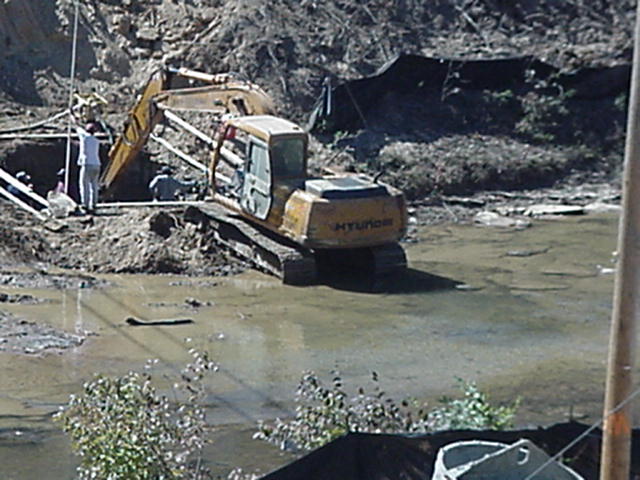
ALDOT created a road into private property without permission of the property owner. A gate was destroyed allowing illegal entrance to the property for over 10 years. This has created an area of trash, litter and erosion of ALDOT right of way.


We have spoken with ALDOT about this situation many times only to be met with empty promises and more pollution.

The right of way in question is far beyond the normal right of way width. It should have been remanded to the property owner when abandoned by ALDOT. They have stubbornly refused to allow the owners to make improvements to stop the erosion across their adjacent property.

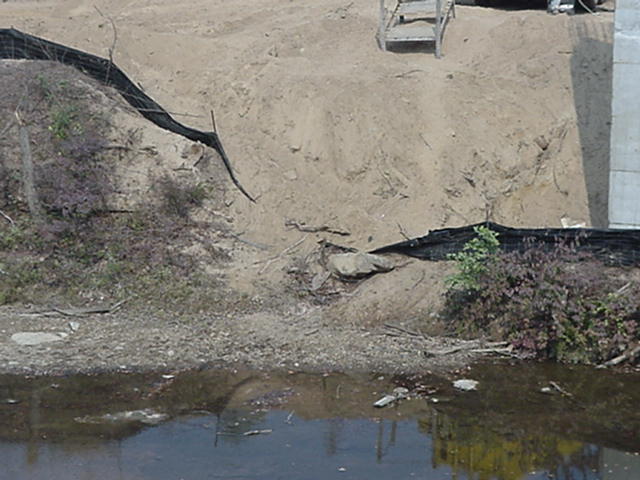
Deep rills and erosion gullies get worse with every rain event. ALDOT has refused to block off the illegal entrance they created so the entire responsibility for this problem lies with them.

This illegal road drains directly into a segment of Hurricane Creek protected by TMDL as it has for over 10 years of this discharge. I have included photos from as far back as 2007. We have many more.

ADEM and ALDOT have been called but the situation still exists. Now ALDOT has refused the park authority access to the park for a road leading from the abandoned right of way. Since ALDOT wants to hold onto the property, they MUST keep it from eroding and causing a visible violation of the TMDL and the ALDOT general storm water permit.

On 10/27/10 I visited the site or inspection purposes. I took the photos found in PDF ALDOT 10/27/10 current erosion.
It shows the situation as it exists today.


ALDOT past erosion shows the history of problems created by ALDOT building the road into private land without permission. This trespass is the cause of problem. As long as ALDOT owns the property, they are responsible for its upkeep and accountability for failure to comply.


We respectfully request EPA to consider enforcement since ADEM has taken no action to curb the pollution for over 10 years.


John L. Wathen
Hurricane Creekkeeper,
Friends of Hurricane Creek

Members of
WATERKEEPER Alliance
http://www.waterkeeper.org

Who has the authority to say someone else
is not being a good steward of the environment?

Anyone who notices.