Monday, March 15, 2010

New storm drainage rules to cost city nearly $250,000

New storm drainage rules to cost city nearly $250,000


Staff photo | Robert Sutton
Stormwater rushes through a culvert and into a creek that feeds into the Black Warrior River after heavy rain Wednesday morning. The culvert is behind the ABC Store on 21st Avenue, between Jack Warner Parkway and University Boulevard.
By Robert DeWitt Senior Writer
Published: Thursday, March 11, 2010 at 3:30 a.m.
Last Modified: Wednesday, March 10, 2010 at 10:24 p.m.
TUSCALOOSA | The city of Tuscaloosa must soon find an estimated $200,000 to $250,000 to implement new storm drainage regulations.

The regulations are intended to prevent pollutants from washing into the Black Warrior River, Lake Tuscaloosa and other public waters, but they also are an unexpected blow to the city’s budget.
“We’re all on the same page for implementing better practices to safeguard our environment,” Mayor Walt Maddox said. “However, this is a prime example of an unfunded mandate, where Washington passes down to Montgomery and Montgomery passes to the cities regulations they can’t afford to enforce.”
The Alabama Department of Environmental Management is imposing the regulations, which originated with the federal Environmental Protection Agency. So a state law that prohibits the state from placing unfunded mandates on local governments does not apply in this case.
“There’s no new money being allocated and there’s no more money being generated by the economy, so we’ll have to take away from some city department,” Maddox said. “My complaint is having to find $250,000 in what is already one of the most difficult budget years we’ve seen. And it’s not like we’ve had an opportunity to plan for it.”
The mandate will change in two significant ways how the city regulates stormwater:
The city will take on the primary responsibility for enforcing stormwater runoff regulations at construction sites during and after construction.
That responsibility has belonged to ADEM. 
The city also must do some water quality testing, something it does not do now.


A committee of city staff members is forming recommendations on implementing the new regulations. That task should be completed in two to three months, with implementation expected about six months later, said Chad Christian, the city’s stormwater drainage engineer.
Although the city has been involved in enforcing regulations concerning runoff from construction sites, it does not have the manpower to assume primary responsibility, Christian said. The city might need as many as eight to nine more employees to do that.
“It would take a lot more staff,” Christian said.
Until now, the city has been primarily involved in educating the public about ways to reduce pollution in stormwater drainage and minimize pollution created by municipal operations, spending about $50,000 on those efforts. The changes will increase its annual spending on stormwater pollution control to between $250,000 and $300,000, according to estimates provided by the EPA.
The regulations stem from the Clean Water Act, passed by Congress in 1971. It first targeted “point source” pollution, which includes things like a wastewater treatment plant discharge or an industrial discharge, Christian said.
When regulating point source pollution did not completely clean up pollution problems, the EPA turned to non-point source pollution. That comes from things like runoff from old mines or city stormwater.
“Rain washes everything off of the rooftops and streets into the water,” Christian said.
Oil, radiator fluid and other pollutants collect on the streets, along with dirt and trash like cigarette butts, plastic bottles and paper cups. It all washes into the river when it rains.
Much of the storm drainage on the south side of Tuscaloosa washes out through Moody Swamp. That helps cut down on pollution.
“You get a tremendous water quality benefit from a natural wetland,” Christian said. “It filters a lot of things out.”

But the northern areas of the city are hilly, resulting in pollution and sediment washing directly into the river or tributaries of the river, since there is little to filter the runoff.
Sediment creates two problems: Pollutants like oil, grease, pesticides, chemicals and heavy metals attach to the grit and are carried by it into the stream, Christian said. And sediment builds up in waterways, posing a serious problem in places like Lake Tuscaloosa, the city’s primary source of drinking water, which has lost a significant portion of its capacity to siltation.
“Our raw drinking water source has to be protected,” Christian said.
Along Tuscaloosa’s riverfront, much of the stormwater is now being filtered. There is a filtration device in the inlet at the riverboat landing next to the Hugh Thomas Bridge, and the new Bank of Tuscaloosa office complex included a filtration system for stormwater generated on the site. The new Riverwalk Place development and the amphitheater will have similar systems, Christian said.
Christian does not believe stormwater will ever be channeled to a filtration plant and treated like sewage, because it would not be practical, he said. For example, as much stormwater comes through the outlet off 21st Avenue near the Alcoholics Anonymous building in one day during a major rain as would come into the city’s wastewater treatment plant. And there are outlets all over the city.
As standards increase, however, stormwater management will become more expensive. While the city will have to find the money to deal with it, Tuscaloosa does want to protect the waters in and around the city.
“It’s true that we have to do it,” Christian said. “But we want to do it, if for no other reason than to protect Lake Tuscaloosa.”


Sunday, March 14, 2010

Williamsburg Citizen Complaint


 To: Mr. Jim Giattina, EPA Region 4

 Mr. Giattina,

I am writing this complaint and addressing it to you due to the extraordinary circumstances surrounding the permit. ADEM claims the permit terminated but no reclamation has occurred and active construction is on-going. Turbid water and sedimentation are still being discharged with every rain event. It should be noted here that this is a site that has been pointed out in the petition to remove ADEM from authority. SDW is a prime example of ADEM failure to adequately enforce.  We respectfully ask EPA Region 4 to require completion of reclamation by SDW and registration of McKinney Pruden.

 From the Petition to Withdraw NPDES Program Approval ...

 "15.       The State of Alabama has failed to ensure that construction stormwater (CSW) dischargers who are engaged in construction disturbance activities or who have not completed reclamation of disturbed areas renew their expired registrations.  For example:

 ALR165846   SDW, Inc.

SDW, Inc. was initially granted NPDES Registration ALR165846 on September 1, 2004 for construction disturbance within the Williamsburg subdivision.  This registration expired on August 31, 2005.  (Exhibit B-2).  NPDES Registration ALR165846 was reissued to SDW, Inc. on August 4, 2005 for construction disturbance on 14.5 acres within the Williamsburg subdivision.  This registration expired on August 31, 2006.  (Exhibit B-3).  A Warning Letter was issued by ADEM on July 9, 2007.  (Exhibit B-4).  A Notice of Violation was issued by ADEM on January 18, 2008.  (Exhibit B-5).  NPDES Registration ALR165846 was granted to SDW, Inc. on January 28, 2008 for construction disturbance on 4.9 acres within the Williamsburg subdivision.  This registration expired on August 31, 2008.  (Exhibit B-6).  Order 08-203-MNPS was issued by ADEM on September 5, 2008 citing failure to maintain a valid registration on one day.  (Exhibit B-7).  NPDES Registration ALR165846 was granted to SDW, Inc. on June 10, 2009 for construction disturbance on 4.9 acres within the Williamsburg subdivision.  This acreage included Lots 1, 18, 19, 23, 28, 30, 31, 46 and 47.  This registration expired on August 31, 2009.  (Exhibit B-8).  SDW, Inc. engaged in construction disturbance activity without a valid registration from September 1, 2006 to January 27, 2008 (514 days) and from September 1, 2008 to June 9, 2009 (282 days).  (Exhibit B-9).  Despite that construction disturbance activity was continuing on-site after August 31, 2009 (Exhibit B-10) and that reclamation remained incomplete (Exhibits B-11 and B-12), the State of Alabama affirmatively released SDW, Inc. from any requirement to maintain a valid registration or to complete reclamation.  (Exhibit B-13)."

SDW Inc. ALR 165846 has been the source of many complaints, enforcement, and law suit for non-compliant activities at the site. A consent order required that SDW remove a certain amount of sediment from Camden Lake. It should be noted that since the deposition of sediment has never stopped, the required amount of sediment to be removed should be increased to include the time from the consent order to the current date of the removal.


In Nov., 2009 William Donald, attorney for SDW, entered a letter certifying that all reclamation had occurred with the exception of one lot belonging to McKinney Pruden Contractors.

At that time I inspected the site 0n 11/03 and 11/10/09. I took photographs of multiple violations and areas lacking reclamation and sediment entering the street and drains leaving multiple locations within the SDW permit boundaries. A ditch was cut in the top section of the property turning sediment-laden run-off to enter Abbey Trace subdivision down-grade.


According to Mr. Steve Jenkins, ADEM, he inspected the site and found it to be in total reclamation with the exception of the lot mentioned above. Mr. Jenkins seems to have worked very hard to allow this permit to be terminated without proper reclamation or permit transfer to Pruden McKinney.

SDW permitted the entire area of disturbance included in the Williamsburg Subdivision, permit ALR 165846. No permit transfer to Pruden McKinney ever took place. Therefore, SDW maintained responsibility for the site until completion and release or complete reclamation and closure of open disturbance. This is obviously not the case today and has always been in a disturbed condition.

On Aug 31 2009 the permit expired. No complete reclamation had occurred on disturbance created by SDW in the excavation of NPDES "SDW Inc. ALR 165846".


On 03/10/10 I took the following photos and wish to register the following complaint.


 ADEM has allowed SDW to terminate the NPDES permit without proper permit transfer of disturbed acreage.

ADEM has allowed the termination of the NPDES without proper reclamation.

SDW has allowed insufficient ground cover to cause erosion and deposition of sediment off-site.

SDW failed to install and maintain proper BMPs.

SDW failed to provide adequate ground cover.

SDW failed to provide adequate slope cover.

SDW allowed erosion gullies to become established through lack of adequate reclamation along the Abbey Trace / Williamsburg property boundaries..

SDW allowed turbid, silt laden water to enter the Camden Lake, located in the unnamed tributary of Cottondale Creek.

John L. Wathen

Hurricane Creekkeeper,
Friends of Hurricane Creek

Members of
WATERKEEPER Alliance
http://www.waterkeeper.org

Who has the authority to say someone else
is not being a good steward of the environment?

Anyone who notices.

Saturday, March 13, 2010

Camden Lake complaint 03/12/10

To: EPA Region 4

Please accept the following complaint on behalf of John L. Wathen and Friends of Hurricane Creek concerning Builders Group Dev. Camden Lake


ALR 16B471. (BGD)

On 03/02,08,10/10, BGD had the following violations…

 Failed to properly install and maintain BMPs.

Failed to contain construction debris.

Allowed off-site tracking of mud and construction debris into streets.

Failed to provide adequate ground cover throughout the entire development.

Failed to provide approved gravel drive entrances to construction sites.

 Failed to provide adequate stormwater inlet protection.

Failed to provide a retention or detention pond as required.

                a.The basin found on the property is a lake and does not have a stand-pipe, trash screen or any other means of holding any storm surge.

Failed to provide adequate slope grade vegetation.

                 a. Many slopes throughout the subdivision are failing. The most notable is along the unnamed tributary of Cottondale Creek, directly across from Covington Villas. Inadequate measures have been taken to stabilize but all are failing. This will soon be in the creek along with any house built above it.

On 03/02,10/10, allowed turbid, silt laden water to leave the site into the unnamed tributary to Cottondale Creek.

There is NO ongoing construction in Williamsburg except one lot that has been idle for months.
There is NO ongoing construction at Abbey Trace where extensive attention has recently been paid to BMPs.


In my opinion, Williamsburg is contributing also, but most of the turbidity and sediment entering the unnamed tributary of Cottondale Creek can be directly traced back to BGD, Camden Lake.

Slopes surrounding the lake are bare in many places with failing or non-existent BMPs.

Friday, March 12, 2010

Circuit court sharply raises fine for Tuscaloosa developer


ADEM didn’t adequately punish erosion violations, ruling said


John Wathen, head of environmental watchdog group Friends of Hurricane Creek, stands near a ditch at Abbey Trace in 2008 overlooking the construction of Williamsburg subdivision on Buttermilk Road in Tuscaloosa.

By Jason Morton Staff Write

Published: Friday, March 12, 2010 at 3:30 a.m.
Last Modified: Thursday, March 11, 2010 at 11:39 p.m.


A Montgomery County Circuit Court has ruled the Alabama Department of Environmental Management inadequately punished a Tuscaloosa developer for violating erosion control rules.


The Lawsuit
Friends of Hurricane Creek sued SDW Inc., saying runoff from the subdivision was harming a tributary of Cottondale and Hurricane creeks.

The Ruling
The penalty against the developer was increased from $20,000 to $120,500

The ruling, issued Wednesday, increases the penalty against SDW Inc. for its Williamsburg subdivision, a development off Buttermilk Road, from $20,000 to $120,500, based on the minimum $100-per-day fine.

“Although ADEM is not required to impose the penalties recommended by the hearing officer, any finding of violation ... must be assessed at the statutory minimum imposed by the Alabama Code,” according to the ruling. “The Order issued by ADEM cited SDW Inc. for three violations ... and these violations continued for a total of 1,205 days.”

The suit was brought by the Friends of Hurricane Creek, a watchdog group headed by environmental advocate John Wathen.

“Friends of Hurricane Creek has been collecting evidence for years concerning Tuscaloosa developers who do not comply with the regulations,” Wathen said. “This is the first of many successes we expect in the coming years.”

He also said it’s the first time a state court has found that ADEM has improperly cited a developer for violating Alabama’s erosion control rules and ordered the fine increased.

Jerome Hand, spokesman for the state environmental division, declined to comment because of the ongoing litigation.

He did say, however, that ADEM officials had yet to decide whether to appeal the Circuit Court’s ruling. Should an appeal be filed, it will go before the Alabama Court of Civil Appeals.

Steven Dale Williams and Joe R. Lindsay Jr. did not return calls seeking comment on behalf of SDW Inc. The Alabama secretary of state’s Web site lists them as incorporators of the development company in July 2002.

Williamsburg was one of four housing developments on Buttermilk Road, just upstream from the Woodland Forrest Country Club, that Wathen identified in July 2008 as habitual violators of erosion control laws.

He pointed to an island that was growing from a pond near Hole 16 on the golf course. Wathen said the island grows larger with each heavy rain.

Wathen blamed the runoff on developers, whom he says are not using adequate erosion control measures, and the city of Tuscaloosa, which he said issued permits for the subdivisions but has not properly monitored them.

In September 2008, Wathen and Friends of Hurricane Creek filed suit against SDW Inc. for the Williamsburg subdivision, claiming that the runoff was causing environmental harm to an unnamed tributary of Cottondale and Hurricane creeks.

“We believe ADEM to be fundamentally broken and out of touch with enforcement regulations,” Wathen said after Wednesday’s ruling. “Cottondale Creek along Buttermilk Road is a prime example of such development out of control.”

The judge’s ruling came a day after Tuscaloosa Mayor Walt Maddox informed the City Council that it must find an estimated $200,000 to $250,000 to implement new storm drainage regulations.

The regulations are intended to prevent pollutants from washing into the Black Warrior River, Lake Tuscaloosa and other public waters, but they also are an unexpected blow to the city’s budget.

The Alabama Department of Environmental Management is imposing the regulations, which originated with the federal Environmental Protection Agency.

Part of the added responsibility for the city will be the primary enforcement of stormwater runoff regulations at construction sites during and after construction.

Until this mandate, that responsibility belonged to ADEM.

Reach Jason Morton at jason.morton@tuscaloosanews.com or 205-722-0200.


The The Lawsuit


Thursday, March 11, 2010

Citizens Complaint, Covington Villas 03/11/10

To: EPA Region 4 and ADEM

Please accept the following complaint on behalf of John L. Wathen, Hurricane CREEKKEEPER©, Friends of Hurricane Creek, concerning Covington Villas.

Covington Villas, ALR164521

On 03/ 02,08,10/10, Covington Villas had the following violations…

Failed to properly install and maintain BMPs
Failed to contain construction debris
Allowed off-site tracking of mud and construction debris into streets
Failed to provide adequate ground cover throughout the entire development
Failed to provide approved gravel drive entrances to construction sites.
Failed to provide adequate stormwater inlet protection.
Failed to maintain sediment basin.
Failed to provide adequate slope grade vegetation.
On 03/10/10, allowed turbid, silt laden water to leave the site into the unnamed tributary to Cottondale Creek.
No NPDES.

This developer has been operating since 03/09 with no NPDES permit. All discharges into the unnamed tributary to Cottondale Creek have been “unpermitted discharges."
 All violations here are city permitted while the developer has NO NPDES discharge permit.

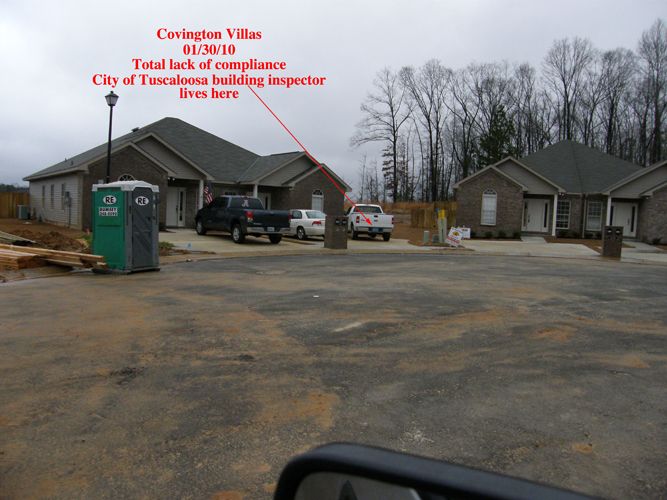
The city of Tuscaloosa issues every house-building permit on the site. They have the ability and authority to demand $500.00 per day, per violation. Since late 2007 there has NEVER been a single fine issued or collected at this location. There has been no attempt by Tuscaloosa engineers or planners to address the 32% reduction called for in the TMDL for Hurricane Creek. All of this is direct evidence of non-complaint behavior on the part of Tuscaloosa as well as the developer. In this case, there is actually a Tuscaloosa building inspector living in the subdivision. He drives through the violations, dirt, and mud daily. He lives next door to one of the worst sites out there. His lack of action is a direct indicator of Tuscaloosa’s unwillingness to enforce the regulations.


I spoke with city engineer Chad Christian about this after unsuccessfully trying to log a complaint on the city 311 line. Chad’s response here in below…
“I have asked Ronnie Pugh to address the concrete truck spills into the ROW and the erosion leaving the vacant lots (with the developer), and the Inspection Department to get the home sites in shape and the road cleaned up (by the builder). If we don’t get satisfaction by the end of this week I plan to go to the magistrate for violation(s) of the City code. We are committed to getting this right and everyone should know better by now.”


Covington Villas is still operating with no BMPs in place and failing BMPs or inadequately installed BMPs. I found NO warnings, stop work orders, or any indication of compliance. I believe this is another case of the city protecting developers from accountability. If this goes before a magistrate, which I doubt, it would be Mr. Burns second offense in a year.

ADEM, has caused no deterrent to Trick Construction and or Burns Construction and their consistent non-complaint conditions. Warnings and orders issued are ignored for the most part. Even EPA Region 4 has had little effect of the conditions of the site. (Burns is also owner of Jamestown Villas, ALR16ECN5)(( Trick is owner of Easton Place ALR16EAAY))

We therefore ask for EPA notices of violation and enforcement orders with penalty.

John L. Wathen
Hurricane Creekkeeper,
Friends of Hurricane Creek

Members of
WATERKEEPER Alliance
http://www.waterkeeper.org

Who has the authority to say someone else
is not being a good steward of the environment?

Anyone who notices.

PRESS RELEASE For Immediate Release

PRESS RELEASE
For Immediate Release
From: Friends of Hurricane Creek

Hurricane Creekkeeper

            John L. Wathen,
         hccreekkeeper@hughes.net
         205-233-1680
         205-507-0867

Re: Circuit Court orders $120,500 minimum penalty for developer’s stormwater violations

03/10/10,

Friends of Hurricane Creek / Hurricane CREEKKEEPER filed multiple complaints concerning the Williamsburg Subdivision, owned by SDW, Inc., for stormwater violations that resulted in sediment and other pollutants leaving the Buttermilk Road development.
(for more info on stormwater violators visit http://mudbuster.blogspot.com )

ADEM fined SDW $20,000 for over 700 days of documented violations. ADEM is required to levy a minimum of $100 per violation per day.

FoHC appealed to the Environmental Management Commission with the help of David Ludder, a Tallahassee attorney for FoHC. FoHC presented evidence to the Commission of over 2,000 days of violations. The Commission refused to modify the ADEM penalty so FoHC filed an appeal to Montgomery Circuit Court.  On March 10, the Court reversed ADEM and ordered that the $20,000 penalty be increased to a minimum of $120,500.

Judge Charles Price signed the attached order yesterday while the Tuscaloosa News press was rolling this headline for the days edition “New storm drainage rules to cost city nearly $250,000”

Friends of Hurricane Creek, Hurricane CREEKKEEPER, hail this as a tremendous victory in the battle against developer produced pollution and run-off!

The price for polluting Tuscaloosa’s waterways just went up. It will no longer be cheaper to break the laws than to obey them.

 The Order…

IN THE CIRCUIT COURT OF MONTGOMERY COUNTY, ALABAMA


FRIENDS OF HURRICANE CREEK,

WATHEN JOHN,

                                               Plaintiffs,

V.    Case No.:   CV-2009-001320.00


ENVIRONMENTAL

MANAGEMENT DEPT OF

ALABAMA,

ALABAMA ENVIRONMENTAL

MANAGEMENT COMMISSION,

SDW INC,

                                               Defendants.


FINAL ORDER


The above-styled matter came before the Court on February 8, 2010 on the

Plaintiff's Motion for Summary Judgment. The Court notes the following facts in

the record:


1.     On September 5, 2008, the Alabama Department of Environmental Management

("ADEM") issued Administrative Order 08-203-MNPS to SDW Inc., assessing a

$20,000 penalty for violations of the ADEM Administrative Code and the Alabama

Water Pollution Control Act at the Williamsburg facility, a residential subdivision

constructed by SDW, Inc., in Tuscaloosa County, Alabama.


2.     The Plaintiffs filed a request for a hearing with the Alabama Environmental

Management Commission ("AEMC") contesting the civil penalty of $20,000

imposed by the Order, contending that the penalty must be set at the mandatory

minimum per the statute.


3.     AEMC dismissed the Plaintiffs' request for a hearing, and plaintiff filed this

appeal.


The Alabama Administrative Procedures Act (“AAPA”) governs the standard of

review of administrative agency’s decision. Ala. Code (1975) §41-22-20. Under the

AAPA, the court may reverse an administrative decision only under limited

circumstances. Based on the record, the Court finds that the ADEM Order 08-203

MNPS is in violation of the statutory provisions. Ala. Code 1975 §41-22-20

(k). Pursuant to the Alabama Code §22-22A-5(18) (c), "any civil penalty assessed .

. . shall not be less than $100.00 or exceed $25,000.00 for each violation, provided

however, that the total penalty assessed in an order issued by the department . . .

shall not exceed $250,000.00. Each day such violation continues shall constitute a

separate violation for purposes of this subdivision." The ADEM and the AEMC's

hearing officer found that SDW violated ADEM rules and regulations. ADEM


Order 80-203 MNPS assessing civil penalties in the amount of  $20,000 against SDW Inc.'s is a clear failure to assess the statutory minimum penalty amount of $100 per day for each violation and $100 per day for each day of continued violation as required by §22-22A-5(18)(c).


Although, ADEM is not required to impose the penalties recommended by the

hearing officer, any finding of violation noted in Administrative Order 08-203

MNPS must be assessed at the statutory minimum imposed by the Alabama Code

§22-22A-5(18)(c). The Order issued by ADEM cited SDW Inc. for three (3)

violations pursuant to ADEM Admin. Code rs. 335-6-12-.05(1), 335-6-12-.11(1),

335-6-12-.05(2), and 335-6-12-.35(10) (a), respectively and these violations

continued for a total of 1205 days (See Order 08-203-MNPS FINDINGS #7, 12,

and 13).


Based on the above stated facts from the record, the Court hereby finds that the

decision of ADEM's assessment of civil penalties in the amount of $20,000 is a

violation of the statutory minimum, which must be imposed at $100 per violation

and $100 per day for each day of continued violation.

Based on the facts and statutory demands, it is ORDERED, ADJUDGED AND

DECREED that ADEM shall assess a civil penalty in the amount demanded by the

statute for the violations cited within Administrative Order 08-203 MNPS.

DONE this 10th day of March, 2010.


 __________ /s/ Charles Price___________

CHARLES PRICE, PRESIDING CIRCUIT JUDGE


John L. Wathen
Hurricane Creekkeeper,
Friends of Hurricane Creek

Members of
WATERKEEPER Alliance
http://www.waterkeeper.org

Who has the authority to say someone else
is not being a good steward of the environment?

Anyone who notices.

Thursday, February 25, 2010

Easton Place citizen complaint 02/24/10

Easton Place citizen complaint

On 02/20,21,22/10, Easton Place, ALR16EAAY, had the following violations…

Failed to properly install and maintain BMPs
All BMPs were either failing or non-existent.
Failed to contain construction debris.
Allowed off-site tracking of mud and construction debris into streets.
Failed to provide adequate ground cover throughout the entire development.
Failed to provide approved gravel drive entrances to construction sites.
Failed to provide adequate stormwater inlet protection.
Failed to provide sediment basin.
All drainage from this site enters the unnamed tributary of Cottondale Creek untreated.
Failed to provide adequate slope grade vegetation.
On 02/22/10, allowed turbid, silt laden water to leave the site into the unnamed tributary of Cottondale Creek.
No NPDES.
This developer has been operating since 03/09 with no NPDES permit. All discharges into the unnamed tributary to Cottondale Creek have been “unpermitted discharges.”
All ongoing construction is via Tuscaloosa City permit while NPDES is invalid.
 On 02/20/10, I flew over the site and photographed many issues.


1.     Offsite tracking was evident and throughout the completed section of residences.

2.     Multiple inlet boxes with no protection.

3.     Ground cover throughout the entire site is too sparse and has not been kept consistent.

4.     Slopes surrounding the site are bare in many places with failing or non-existent BMPs.

a.     Slopes noted by Ms. Janna McIndoe on 01/25, 08/08, and in an NOV dated 09/12/08 are still bare and badly eroded. It is quite evident that this developer fears no repercussions for his lack of compliance.

b.     Dirt piles noted in the same inspections by JM are still there and unprotected.

On 02/21/10 I returned to the site to ground-truth my photos and found the same conditions listed above. There was evidence in many places to indicate where concrete trucks have been using this site for washing trucks for some time.


On 02/22/10, Tuscaloosa received 0.16-inch rain. I visited the Easton Place site and found the following violations.

1.     Turbidity and siltation in the unnamed tributary of Cottondale Creek.

2.     Many BMPs failing on previous visits had not been repaired or replaced.

3.     BMPs that were non-existent were still missing.

4.     Construction debris was in the streets and creek.

5.     Off site tracking was evident at every construction location.

6.     Inlets that were not protected on previous visits were still unprotected.

7.     Slope grades still unprotected.

8.     Major erosion into unnamed tributary to Cottondale Creek

9.     Exposed dirt storage piles.

10.  No NPDES


 In all, I found many of the exact same issues during these last visits that were present since construction began. There seems to be an attitude of non-compliance with this developer, as with most in Tuscaloosa. It is my opinion that this comes from the lack of diligence by the city of Tuscaloosa over single homebuilders and ADEM for overall site compliance. Neither enforcement branch has demonstrated the will and or ability to issue adequate enforcement. All of the above mentioned violations were also noted by ADEM inspector, Janna McIndoe in reports 01/25/08 and again in an inspection report dated 08//0808/. There is no record of any follow-up by ADEM since 09/12/08. In fact, there are only 14 files in the entire folder.
Previous complaints issued by FoHC, 08/23,26/08 (not on record in ADEM files) noted the exact same conditions that exist today. ADEM nor the city of Tuscaloosa have taken any deterrent action. No fines, no follow-up to compliance orders, no penalties, no compliance has been noted at this site. It is and has been in a constant state of violation because, in my opinion, it is cheaper to violate the law than to obey. If there is no consequence to match the violations, there is no accountability.

The city of Tuscaloosa issues every house-building permit on the site. They have the ability and authority to demand $500.00 per day, per violation. Since late 2007 there has NEVER been a single fine issued or collected in the Cottondale Creek Basin on record. There has been no attempt by Tuscaloosa engineers or planners to address the 32% reduction called for in the TMDL for Hurricane Creek. All of this is direct evidence of non-complaint behavior on the part of Tuscaloosa as well as the developer.

ADEM, for the most part has been completely impotent in causing any deterrent to Trick Construction and or Burns Construction (partners at Covington Villas,  ALR164521) and their consistent non-complaint behavior. Warnings and orders issued are ignored for the most part. Even EPA Region 4 has had little effect of the conditions of the sites. (Burns is also owner of Jamestown Villas, ALR16ECN5)

 Until Tuscaloosa, ADEM, and EPA step up to the plate and penalize these consistent violations, they will never stop.


John L. Wathen

Hurricane Creekkeeper,

Friends of Hurricane Creek

Members of
WATERKEEPER Alliance
http://www.waterkeeper.org

Who has the authority to say someone else
is not being a good steward of the environment?

Anyone who notices.

Covington Villas, ALR164521 complaint

Please accept the following complaint on behalf of John L. Wathen, Hurricane CREEKKEEPER and Friends of Hurricane Creek, against Trick Construction, Covington Villas, ALR164521.

On 02/20,21,22,/10, Covington Villas had the following violations…

Failed to properly install and maintain BMPs
Failed to contain construction debris
Allowed off-site tracking of mud and construction debris into streets
Failed to provide adequate ground cover throughout the entire development
Failed to provide approved gravel drive entrances to construction sites.
Failed to provide adequate stormwater inlet protection.
Failed to maintain sediment basin.
Failed to provide adequate slope grade vegetation.
On 02/22/10, allowed turbid, silt laden water to leave the site into the unnamed tributary to Cottondale Creek.
No NPDES.

This developer has been operating since 03/09 with no NPDES permit. All discharges into the unnamed tributary to Cottondale Creek have been “unpermitted discharges.
 All violations here are city permitted while the developer has NO NPDES discharge permit.
On 02/20/10, I flew over the site and photographed many issues.


1.     Offsite tracking was evident throughout the site and throughout the completed section of residences.

2.     Multiple inlet boxes throughout with no protection.

3.     Ground cover throughout the entire site is too sparse and has not been kept consistent

4.     Slopes surrounding the site are bare in many places with failing or non-existent BMPs.

5.     On 02/20/10, Bama Concrete truck was washing out fresh concrete into unnamed tributary of Cottondale Creek.

a.     This was done at the instruction of onsite contractors according to Bama contact.

b.     Each site should have a designated wash out area where the waste can not come in contact with storm drains or streams.

On 02/21/10 I returned to the site to ground-truth my photos and found the same conditions listed above with the exception of the Bama truck. There was evidence in many places to indicate where concrete trucks have been using this site for washing trucks for some time.


On 02/22/10, Tuscaloosa received 0.16-inch rain. I visited the Covington Villas site and found the following violations.

1.     Turbidity in the unnamed tributary was slight in comparison to heavier rains but evident.

2.     Many BMPs that were failing on previous visits had not been repaired or replaced.

3.     BMPs that were non-existent were still missing.

4.     Construction debris was in the streets and creek.

5.     Off site tracking was evident at every construction location.

6.     Inlets that were not protected on previous visits were still unprotected.

In all, I found many of the exact same issues during these last visits that were present since construction began. There seems to be an attitude of non-compliance with this developer, as with most in Tuscaloosa. It is my opinion that this comes from the lack of diligence by the city of Tuscaloosa over single homebuilders and ADEM for overall site compliance. Neither enforcement branch has demonstrated the will and or ability to issue adequate enforcement.
On 02/22/10, I returned and took the following photos, no corrections had been made. Turbid, silt laden water entered the unnamed tributary of Cottondale Creek.
  
The city of Tuscaloosa issues every house-building permit on the site. They have the ability and authority to demand $500.00 per day, per violation. Since late 2007 there has NEVER been a single fine issued or collected at this location. There has been no attempt by Tuscaloosa engineers or planners to address the 32% reduction called for in the TMDL for Hurricane Creek. All of this is direct evidence of non-complaint behavior on the part of Tuscaloosa as well as the developer. In this case, there is actually a Tuscaloosa building inspector living in the subdivision. He drives through the violations, dirt, and mud daily. He lives next door to one of the worst sites out there. His lack of action is a direct indicator of Tuscaloosa’s unwillingness to enforce the regulations.

ADEM, for the most part has been completely impotent in causing any deterrent to Trick Construction and or Burns Construction and their consistent non-complaint conditions since at least 2007. Warnings and orders issued are ignored for the most part. Even EPA Region 4 has had little effect of the conditions of the site. (Burns is also owner of Jamestown Villas, ALR16ECN5)

 Until Tuscaloosa, ADEM, and EPA step up to the plate and penalize these consistent violations, they will never stop.

 John L. Wathen

Hurricane Creekkeeper,
Friends of Hurricane Creek
http://www.hurricanecreek.us

Members of
WATERKEEPER Alliance
http://www.waterkeeper.org

Who has the authority to say someone else
is not being a good steward of the environment?

Anyone who notices.

Camden Lake 09/21/09 Mike Mullen's report

"Please accept the following complaint against BGD, Camden Lake.
This complaint, registered by John L. Wathen, Hurricane Creekkeeper, is based on an inspection performed by Michael William Mullen, CPESC (#2129)

 On 02/21/10 I visited the site at Camden Lake with Michael Mullen, CPESC. He documented many flaws in the overall condition of the development as a whole and many problems associated with the homebuilders.

 
The following six slides are digital aerial photographs taken

by John Wathen on February 20, 2010.

These images by themselves show ample evidence that large

areas of Camden Lake have never been and are not now

stabilized with vegetation as required for sites where

vegetation has been removed and construction is not going to

take place for 6 months or more.

Note that much if not most of the brown in the images is bare

soil not dormant vegetation. This will be confirmed later in

the ground level images.


Numerous slides (2,3,4,6,9,10,15,17,18,19,20,21,22) show

excessive bare soil and demonstrate the failure to fully

implement or fully maintain Best Management Practices to the

maximum extent practicable.

Numerous slides also show conveyances for concentrated flow

that are not stabilized including slides 3,4,6,9,10,12,13,18,19

also demonstrating failure to fully implement or fully maintain

Best Management Practices to the maximum extent practicable.

Slides 3 and 4 show a rather recently cut drainage conveyance

that has no stabilization.

Slides 7 and 8 show poorly installed erosion control blankets

(ECBs) which should be in contact with the ground. Slide 11

shows (hard to see) silt fences that have failed because they

were improperly erected in concentrated flow areas.

Slide 5 shows an incompletely stabilized soil pile with a

drainage ditch placed immediately adjacent to it. Neither of

these constitute Best Management Practices and are indicative

of an overall failure to implement and maintain Best

Management Practices to the maximum extent practicable.

Additionally, slide 12 shows failure to achieve flow control by

failing to prevent concentrated flow or to put concentrated

flows into stabilized conveyances. This represents a major

failure to employ Best Management Practices to the maximum

extent practicable.

Finally, slides 14 and 23 illustrate that sediment is being

delivered and moved down slope throughout this part of the site

and that treatment of pollutants is not achieved to the maximum

extent practicable by Best Management Practices.


Michael William Mullen, CPESC #2129

III
The images in the slides in part III of the report show many more

areas with eroding slopes and excessive bare soil areas both of

which show the failure to implement cover (either temporary

cover such as mulch for newly re-graded home sites or permanent

vegetation on sites that have been idle for more than 6 months).

Even worse, sites with large areas of bare soil are found next to

drop inlet structures where the is no current inlet protection BMP

as shown in slides (19, 21, 22, 30, 32-36). Metal posts were

stacked on 3 of the inlets indicating that inlet protection was

probably there earlier. Inlet protection is supposed to be

maintained until vegetative stabilization is achieved. The site

operator failed to implement and maintain Best Management

Practices to the maximum extent practicable by failing to

establish permanent vegetation on areas inactive for more than 6

months and failing to maintain inlet protection Best Management

Practices.

Numerous slides show little or no effort to control movement of

sediment onto streets via tracking. The gravel used is too small

and does not meet Handbook specifications resulting pollutants

on the road. There were instances where cement-laden water was

drained onto the roadway and there was poor housekeeping

around dumpsters (not visible in picture) with broken glass and

drink containers present. Finally, slides 36-41 and 43 show

problems with slope protection.


Overall, my observations and my professional experience

indicate to me that the Camden Lake subdivision has not

implemented Best Management Practices for erosion and

sediment control to the maximum extent practicable, nor has it

maintained those practices which were implement in a manner

that would be considered anywhere close to achieving best

practicable implementation and maintenance.

Although it was not raining during my inspection the amount of

exposed unstabilized soil, the deposition of sediment in

temporary storage areas in channels and the appearance of the

stream at the site boundary indicates to me that pollutants in

excess of those that would be transported offsite with full and

correct implementation of both erosion and sediment control Best

Management Practices and regular and proper inspection and

maintenance of those measures has and continues to occur upon

significant rain events.

The Camden Lake subdivision in my professional opinion has not

implemented or maintained Best Management Practices for

erosion and sediment control to the maximum extent practicable.

Michael William Mullen, CPESC (#2129)

207 Gail Street

Troy, Alabama 36079

Mr. Mullen’s report indicates some serious issues with the overall condition of the development. While there seems to be limited construction at the site the BMP violations are consistently seen at every home site. The overall condition of the acreage contained in the development is seriously deficient and continuously depositing silt and turbid water to enter waters of the United States.

EPA and ADEM both have spoken with and even tried to “help” the developer overcome these conditions to no avail. Penalties and orders are woefully devoid of any visible deterrent behavior or compliance. It is time for EPA to step in and close this permit completely until all deficiencies have been abated. Meaningful penalties of at least the minimum $100,00 per day, per violation should be imposed at once.

QCP reports on total compliance are greatly exaggerated and not completed by a QCP. In most cases the signer is Mr. Tracy Chris. Mr. Chris is not a QCP. The consent order issued by ADEM clearly states that inspections must be performed by a QCP and reports must be completed also by a QCP. It is my opinion that Mr. Chris has badly misrepresented the conditions at Camden Lake.

"John L. Wathen
Hurricane Creekkeeper,
Friends of Hurricane Creek

Members of
WATERKEEPER Alliance
http://www.waterkeeper.org

Who has the authority to say someone else
is not being a good steward of the environment?

Anyone who notices.

Camden Lake complaint 02/23/10

To: EPA Region 4, Susan Pope and Don Joe,


Please accept the following complaint on behalf of John L. Wathen and Friends of Hurricane Creek concerning Builders Group Dev.
ALR 16B471. (BGD)


On 02/20,21,22,/10, BGD had the following violations…
Failed to properly install and maintain BMPs.
Failed to contain construction debris.
Allowed off-site tracking of mud and construction debris into streets.
Failed to provide adequate ground cover throughout the entire development.
Failed to provide approved gravel drive entrances to construction sites.
Failed to provide adequate stormwater inlet protection.
Failed to provide a retention or detention pond as required.
The basin found on the property is a lake and does not have a stand-pipe, trash screen or any other means of holding any storm surge.
Failed to provide adequate slope grade vegetation.
On 02/22/10, allowed turbid, silt laden water to leave the site into the unnamed tributary to Cottondale Creek.
Turbidity was evident with only 0.16-inch rain total for the day.
There is NO ongoing construction in Williamsburg except one lot that has been idle for months.
There is NO ongoing construction at Abbey Trace where extensive attention has recently been paid to BMPs.
In my opinion, most of the turbidity and sediment entering the unnamed tributary of Cottondale Creek can be directly traced back to BGD, Camden Lake.
On 02/20/10, I flew over the site and photographed many issues unseen from the ground.
1.     Offsite tracking was evident throughout the site

2.     There is a collapsed inlet box directly behind a house under construction. There is a large passage of stormwater under the concrete and causing large erosion rills downgrade.

3.     Multiple inlet boxes throughout with no protection.

4.     Ground cover throughout the entire site is too sparse and has not been kept consistently reseeded.

5.     The area behind Eastview Church on BGD property is in complete non-compliance.

a.     Poor slope cover, bare ground, erosion gullies, failed BPMs, non-existent BMPs, no retention pond before overflow to “pass through pipe”.

 6.    Slopes surrounding the lake are bare in many places with failing or non-existent BMPs.


 On 02/21/10, I visited the site to ground-truth my photos in anticipation of rain and found the same violations listed above.


On 02/22/10, Tuscaloosa received 0.16-inch rain. I visited the Camden Lake site and found the following violations.

1.     Turbidity in the unnamed tributary was slight in comparison to heavier rains but evident.

2.     Many BMPs that were failing on previous visits had not been repaired or replaced.

3.     BMPs that were non-existent were still missing

4.     Construction debris was in the streets and creek

5.     Off site tracking was evident at every construction location.

6.     Inlets that were not protected on previous visits were still unprotected.


In all, I found many of the exact same issues during these last visits that were present in 2007 when I started to document this location in detail. There seems to be an air of complacency with this developer. ADEM has demonstrated the lack of will and or ability to issue adequate enforcement.

ADEM, for the most part has been completely impotent in causing any deterrent to BGD and their consistent non-compliant conditions since at least 2007. Warnings and orders issued are ignored for the most part. Even EPA Region 4 has had little effect of the conditions of the site.

John L. Wathen
Hurricane Creekkeeper,
Friends of Hurricane Creek

Members of
WATERKEEPER Alliance
http://www.waterkeeper.org

Who has the authority to say someone else
is not being a good steward of the environment?

Anyone who notices.

Tuesday, February 2, 2010

Citizen Complaint Covington Villas ALR164521.

Citizen Complaint Covington Villas ALR164521.


No NPDES
NPDES expired in March 09.
A warning letter was issued by ADEM
City of Tuscaloosa continues to issue building permits despite expired NPDES.

No BMPs around construction areas
Lack of cover on slope grades
Offsite tracking
Failure to contain construction debris and trash.
Lack of vegetative cover throughout the entire construction area.
Failure to install and maintain curb inlet protection.
Failure to provide and use proper gravel entries in many places through the site.
Concrete trucks wash out in drains and over the back of the cul-de-sac directly into the unnamed tributary to Cottondale Creek.
Failure to maintain sediment basin.
The one shown in the photo has completely filled in and has trees growing with heavy grass inside. This has greatly reduced the retention time for storm-water and is now just a pass through for sediment.

Trick Construction and Burns Construction are jointly building here. Both are chronic violators with history with ADEM and EPA.

Trick also owns Easton Place under “Trickster Construction” Burns owns Jamestown Villas, Barrett Trace, Mimosa Park, all with previous violations for BMPs and non permitted activity.

Mr. Joe Don, EPA region 4 confronted this developer during a recent site visit. He warned Trick to install BMPs and keep them in place. Obviously My Trickster has little concern for EPA and your warnings. When are you going to enforce the regulations and penalize these chronic and willful violators?

It should be noted here that all of the violations listed here are from sites permitted by the city of Tuscaloosa building department while the NPDES is invalid. Tuscaloosa claims it is not responsible for enforcing state permitting regulations. I disagree. No building permit should be issued to any developer without verifying a valid NPDES. The city does have certain responsibilities to enforce BMP regulations and deter offsite deposition of pollutants into waterways of the U.S. By continually issuing building permits to developers known to be chronic violators and not enforcing BMP codes, Tuscaloosa City is in effect violating their own storm-water permit.

I have photographed an inspector truck on Sundays there on more than one occasion. He has possibly taken up residence in this location. It is parked among some of the worst violations in the complex and has to drive through it daily to and from work. I take that as an insult to the community and a strong indicator of Tuscaloosa's unwillingness to enforce the codes. Inspectors have been given the authority to issue warnings, stop work orders, and citations. They were trained at taxpayer expense on more than one occasion to perform the task.

EPA must take action in light of the chronic nature of these complaints and failures.

 John L. Wathen
Hurricane Creekkeeper,
Friends of Hurricane Creek

Members of
WATERKEEPER Alliance
http://www.waterkeeper.org

Who has the authority to say someone else
is not being a good steward of the environment?

Anyone who notices.

Monday, February 1, 2010

EPA petition could mean tighter rules

ADEM’s regulatory practices concerning pollution will be reviewed


By Jason Morton Staff writer, Tuscaloosa News
Published: Monday, February 1, 2010 at 3:30 a.m.
Last Modified: Sunday, January 31, 2010 at 11:58 p.m. 
TUSCALOOSA | Municipalities and industries across Alabama would see tougher regulatory enforcement if the federal Environmental Protection Agency sides with a coalition of state environmental groups.
The Alabama Rivers Alliance, which includes Friends of Hurricane Creek in Tuscaloosa County, earlier this month filed a petition with the EPA claiming the Alabama Department of Environmental Management is incapable of adequately enforcing water pollution regulations.
The petitioners asked the EPA to review ADEM’s regulatory practices regarding water pollution, discharge and soil runoff. Should the federal agency agree the Clean Water Act is not being enforced, the EPA could step in to assume that role.
Business leaders and officials in local government who work with ADEM so far have been cautious in speaking publicly about the petition. However, some contend the state is applying a reasonable and fair level of enforcement.
“The city of Tuscaloosa has and will continue to be cooperative with both state and federal agencies in their efforts to enforce environmental laws,” said City Engineer Joe Robinson.


Robinson declined to comment further, despite the coalition’s many references to Tuscaloosa as an example of what is wrong with ADEM’s water quality enforcement.
John Wathen, who heads Friends of Hurricane Creek, said developers across Alabama could be subjected to tighter rules, if not from ADEM and the EPA, then from the municipalities in which they operate.
“We feel that ADEM has more or less been non-existent,” said Wathen, involved in drafting the petition. “Part of that failing is ADEM’s failure to regulate the city of Tuscaloosa and its storm water (discharge) permits.”
As an example, Wathen pointed to the city’s approval of Jamestown Villas, a 23-acre residential development off Crescent Ridge Road under construction since June 2009.
In October, the construction project and its developer, Northport-based Burns Construction Co., became the target of criminal and civil allegations regarding storm water runoff and erosion coming from the work site.
The civil suit, filed by nearby landowners, is still pending in Tuscaloosa County Circuit Court.
Jimmy Burns, the owner and developer of the 90-unit garden home subdivision, pleaded not guilty to the misdemeanor criminal charges and has said the court actions are the result of political and personal agendas.
Burns also said the site was inspected by engineers for the city of Tuscaloosa, ADEM and the U.S. Army Corps of Engineers, and they all determined the development was in compliance with current soil erosion control rules.
Wathen, however, contends the erosion and environmental rules were not followed.
“If the state won’t (enforce regulations), then we have no recourse than to ask for federal intervention,” he said.
Another industry that could see tighter enforcement is coal mining.
Jim Walter Resources, which operates underground coal mines in Brookwood, has ADEM permits that regulate the industry’s storm water runoff and drainage.
Like the city of Tuscaloosa, officials for Jim Walter are not saying much about the petition to the EPA. Jim Walter spokesman Dennis K. Hall said the company is routinely visited by ADEM representatives and regularly submits water samples for testing taken from areas determined by the state.
“I think you’ll find that we have never been given any special treatment,” Hall said. “We’ve worked well with ADEM since we’ve been here ... (but) over the years, we’ve been fined and we don’t agree with all of the fines. A lot of the fines have to do with what Mother Nature does.”
Wathen, though, believes stricter storm water runoff enforcement would prevent the blooms of discoloration and iron-based bacteria now in Hurricane Creek.
“Every mine discharge in the watershed today has bacteria that’s associated with acid mine drainage,” Wathen said. “That is a violation of the law.


“Our rights have not been observed.”
Reach Jason Morton at jason.morton@tuscaloosanews.com or 205-722-0200.